Roth conversions: how much to convert, and when
A Roth conversion means paying tax now so the money grows and comes out tax-free later. Whether that's a good trade depends on more than your tax bracket: the same dollar of conversion can also raise your Medicare premiums, shrink an ACA subsidy, and change what your heirs receive.
Convert in the years when the tax you pay now is lower than the tax you, your surviving spouse or your heirs would pay later, counting every cost the extra income triggers, not just the bracket. For many households those years fall between retirement and the start of Social Security and required withdrawals. The right amount usually changes from year to year.
What a Roth conversion is
You move money from a pre-tax account, such as a Traditional IRA or a 401(k) you've rolled over, into a Roth IRA. The amount you convert counts as ordinary income for that year. After that, qualified withdrawals from the Roth are tax-free, and the Roth has no required minimum distributions during your lifetime.
There's no income limit and no annual cap on conversions. The question is never "can I?" but "how much, in which years?"
What a conversion really costs
The visible cost is federal income tax. The hidden costs come from the other rules that look at your income:
Federal and state tax
The conversion is taxed at your top bracket. A large one can push part of it into the next bracket up. Your state may tax it too.
Medicare IRMAA
Medicare premiums rise in steps once income crosses set thresholds, based on your income two years earlier. One dollar over a threshold can cost a full step for the year.
ACA premiums before 65
Marketplace premium subsidies are based on income, so conversion income can reduce them or end them.
Social Security tax and NIIT
Conversion income can make more of your Social Security benefit taxable, and can push investment income over the 3.8% net investment income tax threshold.
What a conversion can save
- Smaller required withdrawals. Required minimum distributions start at 73, or 75 if you were born in 1960 or later. Less pre-tax money means smaller forced withdrawals in years when your income may already be high.
- The survivor's tax bill. After one spouse dies, the survivor usually files as single within a year or two, with brackets about half as wide, while the pre-tax accounts stay the same size.
- Your heirs' taxes. Most non-spouse heirs must empty an inherited IRA within 10 years, often during their own peak-earning years. Inherited Roth money generally comes out tax-free.
- Tax-free growth. Whatever the Roth earns after the conversion is never taxed again, if the rules are met.
The conversion window
Many households have a stretch of years with unusually low taxable income: after paychecks stop, but before Social Security and required withdrawals begin. Converting in those years can fill the low brackets that would otherwise go unused.
The window is also where the trade-offs are sharpest. Before 65, conversion income can cost ACA subsidies. From 63 on, it can raise Medicare premiums two years later. And the bigger the pre-tax balance, the more it pays to start early, because required withdrawals will be larger later.
Why rules of thumb miss
"Fill up the 22% bracket every year" is a common rule. It's a reasonable starting point, but it can't see:
- an IRMAA threshold just below the top of that bracket;
- ACA subsidies you'd give up in the years before Medicare;
- the years after the first death, when the survivor's brackets shrink;
- your heirs' likely tax rates, and the 10-year deadline they'll face;
- a move to a state with a different income tax;
- what market returns do to the size of future required withdrawals.
Seeing all of that means modeling every year of your retirement at once, with each year's conversion affecting every later year. See common rules against an optimized strategy on a real sample household →
How Corvana Studio sizes conversions
Corvana Studio models your household year by year: every account, Social Security, pensions, federal and state taxes, IRMAA, Medicare and ACA premiums, required withdrawals, and the 10 years your heirs have to empty inherited accounts.
The optimizer then searches tens of thousands of strategies for a conversion amount in each year, together with the order you draw from your accounts, toward the goal you choose: the lowest lifetime cost, the largest legacy, or a balance of the two. Conversions are sized against the tax brackets and IRMAA thresholds each year, and the result shows you exactly what moved, every year.
A worked example
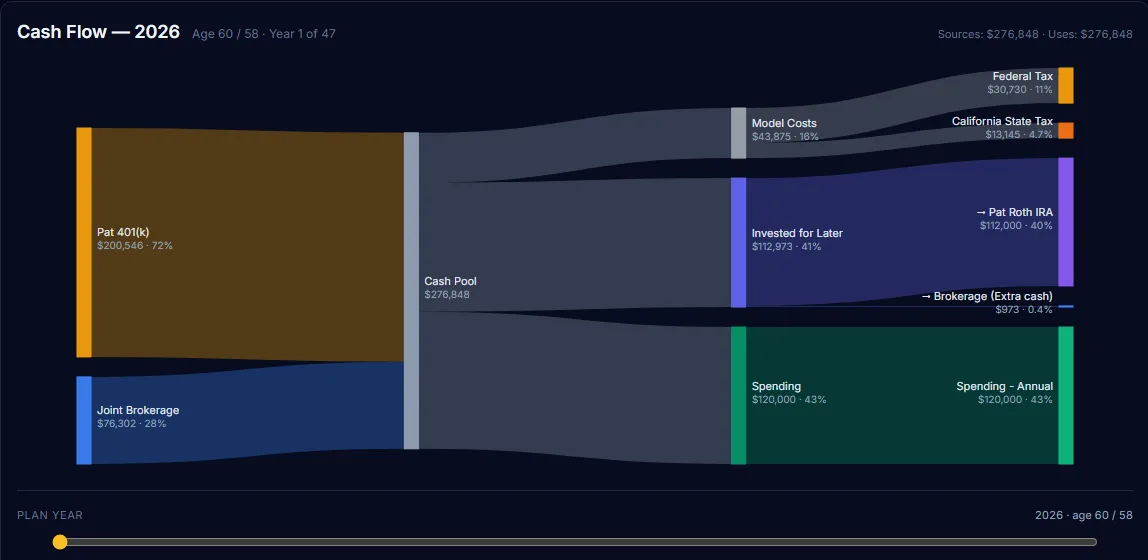
Here's what the optimizer found for one of the app's sample households, balancing lifetime costs against what's left to heirs.
A couple a few years from retiring with large pre-tax balances and a window to do Roth conversions in lower brackets before RMDs and Medicare begin.
- Lifetime taxes & premiums
- $1.15M → $1.05M −$107k
- Left to heirs
- $13.53M → $17.14M +$3.61M
- Monte Carlo success
- 97.2% → 97.8%
The optimizer converts about $350k a year from 2030 to 2033, $1.40M in all, with a different amount each year.
"Left to heirs" is the estate after taxes, including the 10 years heirs have to empty inherited accounts. Sample household with made-up figures; an illustration, not a forecast or advice.
Rules worth knowing
- No undo. Since 2018 a conversion can't be reversed, so convert what you're sure of. Many people convert late in the year, once their income is clearer.
- December 31 deadline. A conversion counts for the calendar year it happens in. There's no April extension like there is for contributions.
- Required withdrawals come first. In a year you owe a required minimum distribution, take it before converting. The required amount itself can't be converted.
- Five-year clock before 59½. Each conversion has its own five-year clock. Withdrawing converted money before 59½ and before that clock runs out can cost a 10% penalty.
- Pay the tax from outside the IRA if you can. Using taxable savings to pay the tax keeps more money growing in the Roth.
- After-tax money in IRAs is pro-rated. If any of your IRAs hold after-tax contributions, each conversion is part taxable and part not, in proportion across all your IRAs.
See your own conversion years
Enter your accounts and ages and see every year, in your browser with no account. A free account includes 3 optimizer runs.
This guide is general education, not tax, investment or legal advice, and the figures above come from a sample household with made-up numbers. Tax rules change, and your situation may differ. Consider reviewing a conversion decision with a tax professional.